Introduction
As we approach 2026, quantum computing is undergoing a fundamental transition. It is moving beyond physics labs into an era of early commercialization. For UAE businesses, the conversation is shifting from "how does it work?" to "how do we prepare?"
While the timeline for a fully fault-tolerant quantum computer is still unfolding, the "Quantum Era" has effectively begun in the Emirates. From the approval of the National Encryption Policy to the arrival of world-class hardware at TII, the infrastructure is being built today. This guide outlines the critical milestones for 2026 and the strategic steps UAE leaders must take now.
1. Policy Alert: The "Q-Day" Preparation
- The UAE is not just watching this revolution; it is hosting it. 2026 is set to be a landmark year for local quantum advancement.
- The Summit: Mark your calendar for April 7–9, 2026. The Quantum Innovation Summit returns to the Grand Hyatt Dubai, hosted by the UAE Cyber Security Council. The theme, "Quantum Frontiers," will bring together global experts to define the region's roadmap.
- TII & "Helios" (The Hardware): Abu Dhabi's Technology Innovation Institute (TII) has secured access to Quantinuum’s "Helios" system. Unlike older machines, Helios offers 50 logical qubits (created from 98 physical qubits). This is a massive leap in fidelity, giving UAE researchers access to one of the most accurate quantum computers in the world.
- Education: Local talent is rising. Institutions like Khalifa University and MBZUAI are now actively offering minors and research tracks in Quantum Computing, feeding the local workforce pipeline.
2. Policy Alert: The "Q-Day" Preparation
The most urgent update for CIOs and CISOs is the UAE's National Encryption Policy, approved in late 2025.
- The Mandate: The policy explicitly calls for government entities and critical sectors to develop transition plans to Post-Quantum Cryptography (PQC).
- Why Now? (Harvest Now, Decrypt Later): Even though quantum computers cannot break encryption today, hackers are stealing encrypted data now to decrypt it later when the technology matures.
- The Action: The policy requires an immediate "Cryptographic Inventory"—an automated audit of every key and certificate in your organization to identify vulnerabilities.
3. Real-World Applications: Where Value is Emerging
Quantum computing is finding its first commercial footholds in problems that are naturally complex.
- Energy (ADNOC Partnership): In a landmark project, TII and ASPIRE are collaborating with ADNOC to use quantum sensing technology. They are applying it to monitor Carbon Capture and Storage (CCS) sites with unprecedented precision and to model battery chemistry for sustainable energy solutions.
- Logistics: With Dubai being a global port hub, quantum annealing is being explored to optimize complex shipping routes and container distribution in real-time.
- Finance: Banks in the DIFC are testing quantum algorithms for high-speed portfolio optimization and fraud detection, analyzing vast datasets faster than classical supercomputers.
4. The 2026 Global Trend: "Hybrid" is the New Standard
The industry has moved past the idea that quantum computers will replace your laptop. The standard for 2026 is Hybrid Workflows:
- Classical Computers handle the logic, data processing, and user interface.
- Quantum Processors (QPUs) act as specialized accelerators—similar to how GPUs power AI—handling the heavy optimization or simulation tasks.
5. Strategic Roadmap for UAE Leaders
If you are a decision-maker in the UAE, here is your 3-step checklist for 2026:
- Educate & Attend Send your technical leadership to the Quantum Innovation Summit in April. Understanding the ecosystem is the first step to identifying opportunities.
- Secure Your Data (Immediate Priority) Audit your data today. If you hold sensitive records (medical, national infrastructure, or banking) that must remain secret for 10+ years, you are already at risk. Start your migration to Post-Quantum Cryptography (PQC) immediately to comply with the new National Policy.
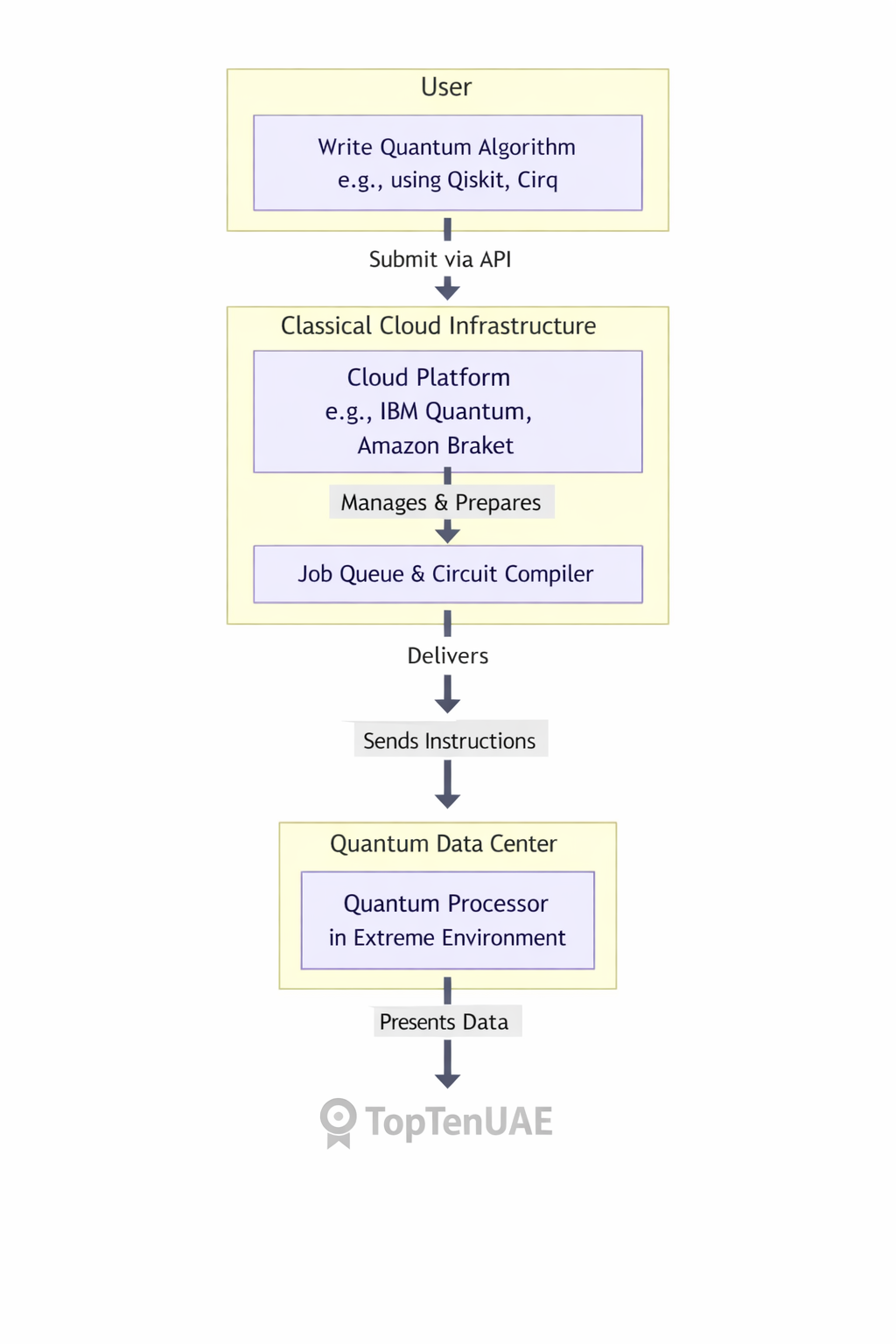
- Experiment via the Cloud (QaaS) The most common question business leaders have is: "How do I actually use a quantum computer? Do I need to buy one?"
The answer is No. You use it via the cloud (API), just like you use ChatGPT or AWS today. You send a problem to the quantum processor, it calculates the solution, and sends the data back to your classical laptop.