
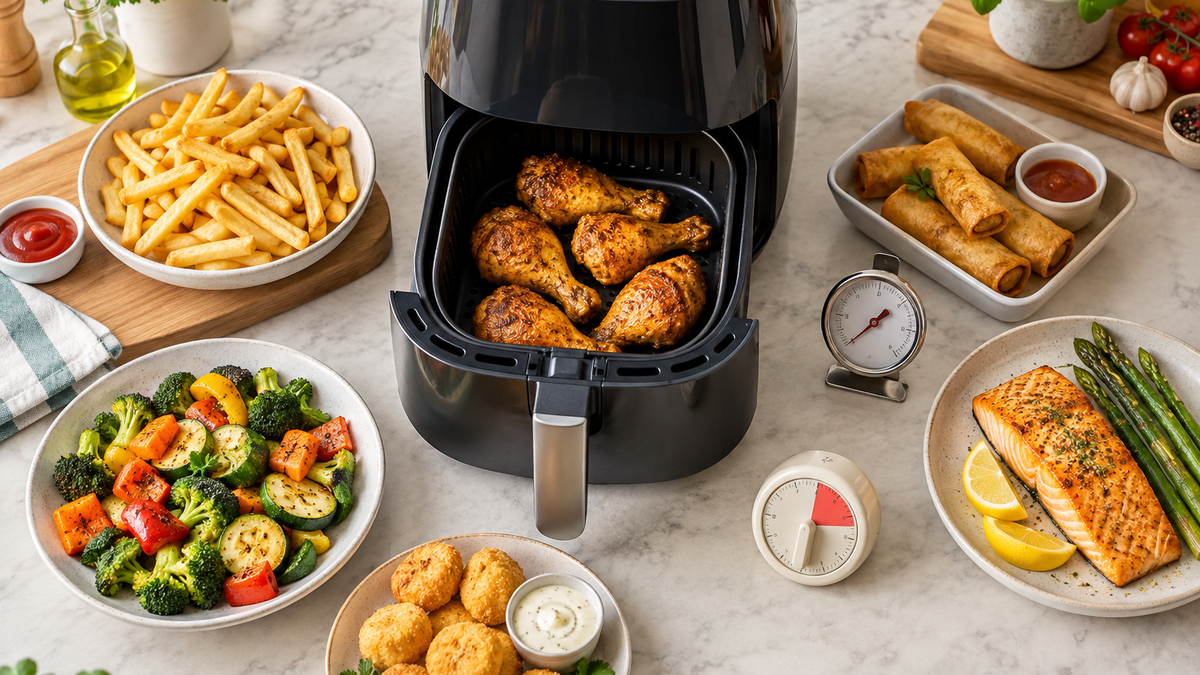
Quick-reference starting ranges
| Food | Starting temperature | Starting time | Mid-cook action |
|---|---|---|---|
| Frozen thin fries | 180–200°C | 10–18 min | Shake once or more |
| Fresh potato wedges | 180–200°C | 18–28 min | Turn or shake |
| Chicken wings | 180–200°C | 18–25 min | Turn; verify internal temperature |
| Boneless chicken pieces | 180–200°C | 12–20 min | Turn; thickness changes time |
| Fish fillet | 170–190°C | 8–15 min | Check early; avoid overlap |
| Mixed vegetables | 170–200°C | 8–18 min | Toss or turn |
| Frozen spring rolls | 180–200°C | 8–14 min | Turn if browning unevenly |
| Reheated pizza slice | 160–180°C | 3–7 min | Check early |
These editorial ranges are deliberately broad. Treat the lower end as the first check point, not the finish time. Use the food manufacturer’s air-fryer instructions where supplied.
Five factors that change the time
- Food thickness and piece size.
- Fresh, chilled, frozen or partly thawed starting condition.
- Basket load, layers and airflow.
- Whether the recipe assumes a cold or preheated chamber.
- The model’s heating design, control accuracy and basket shape.
If the load is deeper than the tested recipe, check the food-capacity guide and redistribute food rather than simply increasing heat.
Cold start versus preheated start
A recipe developed in a preheated air fryer can brown faster than the same timer in a cold machine. Do not add both a long preheat and the full cold-start time without checking early.
Use the air fryer preheating guide to decide which start condition your model and recipe expect.
Fries and frozen snacks
Cook from the package instructions when available. Keep loose frozen pieces separated, avoid a compressed heap, and shake at least once when the model and food allow it. Added oil is often unnecessary for pre-oiled frozen foods.
Chicken and meat
Time alone does not prove safety. Use a clean food thermometer at the thickest point, avoiding bone. FoodSafety.gov lists 74°C for poultry, 71°C for ground meats, and 63°C plus a three-minute rest for whole cuts of beef, pork, veal and lamb.
Fish
Fish thickness varies greatly. Start checking early, especially for thin fillets, and avoid stacking delicate pieces. FoodSafety.gov lists 63°C for fish or cooking until the flesh is no longer translucent and separates easily with a fork.
Vegetables
Dry the surface, cut evenly and account for density: broccoli florets cook much faster than thick carrots or potato. Tossing halfway improves exposure when pieces overlap.
Reheating
Use a lower temperature and short checks for pizza, pastries and cooked meat so the outside does not over-brown before the centre warms. Reheat leftovers safely according to local food-safety guidance; do not use texture alone as the safety check.
How to adjust a chart result
| Result | Next change |
|---|---|
| Pale but cooked | Add a short high-temperature finish if the food permits |
| Brown outside, underdone inside | Lower temperature and extend time; use a thermometer |
| Uneven | Reduce load and turn, shake or rotate |
| Dry | Check earlier, reduce temperature or use thicker pieces |
| Soft underneath | Improve airflow and remove an obstructive liner |
For pale or soggy results, follow the full not-crispy troubleshooting checklist.
Does a larger air fryer need more time?
Not necessarily. The heater, airflow, load and food arrangement matter more than litres alone. Two appliances with the same stated capacity can produce different results.
Our air fryer size guide explains why nominal litres are not a cooking-time formula.
Final recommendation
Save your successful time, temperature, load weight and whether you preheated. That personal chart will become more accurate than any generic reference because it describes your food and machine.
If inconsistent controls or basket shape are holding you back, compare current options in our Best Air Fryers in UAE guide.