
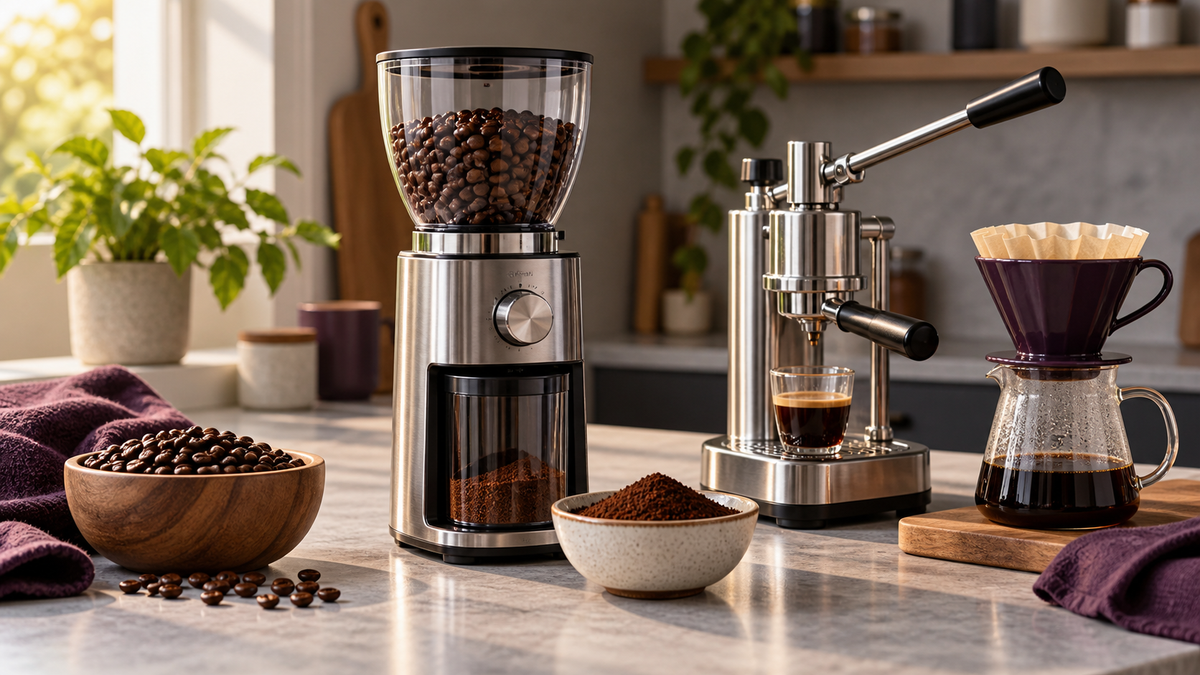
Quick grinder decision
| Brewing setup | Need a grinder? | What matters |
|---|---|---|
| Capsule machine | No | Buy the exact compatible capsule family |
| Filter + pre-ground coffee | No | Buy the correct filter grind and use it while fresh |
| Filter + whole beans | Yes | Consistent medium-range burr grind |
| Manual espresso + pre-ground | Not strictly | Freshness and basket suitability limit adjustment |
| Manual espresso + whole beans | Yes | Fine, repeatable burr adjustment and controlled dosing |
| Bean-to-cup | No separate grinder | Integrated grinder is part of the machine |
Whole beans vs pre-ground
Whole beans let you grind closer to brewing and adjust for the machine. Pre-ground removes equipment and mess, but its fixed grind may run too fast or slow for a particular espresso basket and loses aroma faster after opening. Buy smaller amounts and store them sealed away from heat, light and moisture.
Blade vs burr grinders
Blade grinders chop coffee into a broad mix of particle sizes and control quantity mainly by time. Burr grinders crush beans through a controlled gap, giving more repeatable size. That consistency matters most for espresso, where small changes can alter flow sharply.
Espresso requirements
- Fine adjustment steps—or stepless control—help dial shot time and yield.
- The grinder should dose repeatably with limited retention and clumping for your workflow.
- A pressurised basket may tolerate supermarket pre-ground coffee better than a single-wall basket, but confirm the supplied baskets.
See how grinder work changes the machine decision in the manual vs automatic espresso guide.
Filter requirements
Filter brewing is more tolerant but still benefits from an even grind. Match size to the brewer and paper or reusable filter; too fine can slow flow and increase bitterness, while too coarse can produce a thin cup. Ratio and water also matter.
Integrated vs separate grinder
| Question | Integrated grinder | Separate grinder |
|---|---|---|
| Counter layout | One appliance body | Two appliances and usually two sockets |
| Convenience | Coordinated workflow | Extra transfer step |
| Upgrade path | Replace/service within machine platform | Upgrade brewer or grinder independently |
| Use across methods | Usually tied to espresso machine | Can serve filter and espresso if range permits |
| Repair impact | Grinder fault affects combined machine | Brewer and grinder remain separate |
The Sage Barista Express is a documented integrated-grinder manual example; a narrow De’Longhi Dedica needs pre-ground coffee or a separate grinder. Neither layout is automatically smaller once all accessories are counted.
Compare the Sage Barista Express review and De’Longhi Dedica review for those verified workflows.
Cost, space and maintenance
Budget for grinder, dosing tools, cleaning brush and possible replacement burrs. Keep the hopper and burr chamber dry unless the manual expressly allows another method. In a UAE kitchen, avoid placing beans or the grinder beside a hot oven, sunny window or steamy kettle.
Beginner vs enthusiast
A beginner can start with quality pre-ground coffee and a compatible pressurised basket or filter brewer, then add a grinder. An enthusiast seeking repeatable espresso should prioritise grinder capability before decorative machine features.
Common mistakes
- Buying a blade grinder for espresso because it is labelled “coffee grinder.”
- Assuming one numbered setting matches another grinder or coffee.
- Filling a large hopper with weeks of beans beside heat or sunlight.
- Adjusting grind without tracking dose and beverage yield.
- Adding a grinder after measuring only the coffee machine footprint.
Final recommendation
Skip a grinder for capsules or convenient pre-ground brewing. Choose a burr grinder for whole beans, and treat fine adjustment as essential for non-pressurised espresso.
Return to how to choose a coffee maker or compare all four brewing formats; current machines are in Best Coffee Makers in UAE.