
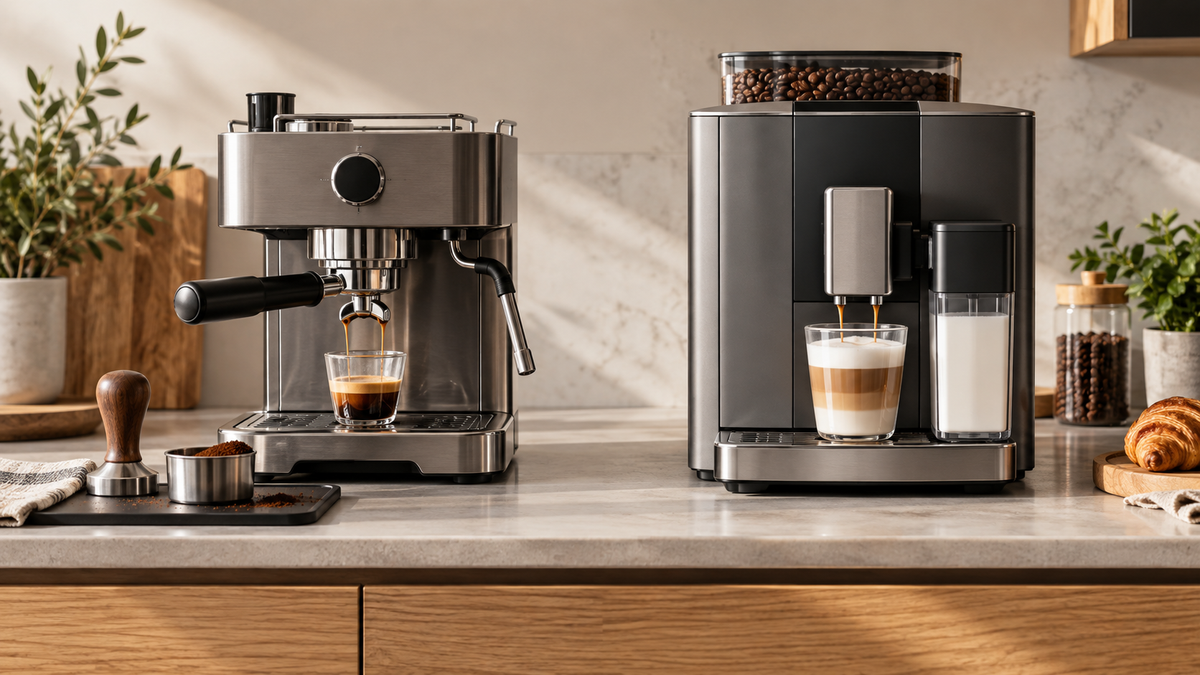
First, decode “automatic”
| Term | Usually automated | Still done by the user |
|---|---|---|
| Manual lever | Little or none of pressure/flow | Grind, dose, tamp, pressure/flow and milk |
| Semi-automatic | Pump pressure | Grind, dose, tamp and stop/start shot on many models |
| Automatic volumetric espresso | Pump and programmed shot volume | Usually grind, dose, tamp and milk |
| Fully automatic/bean-to-cup | Grinding, dosing, tamping internally and brewing | Refill, settings, emptying, cleaning; milk depends on model |
Control and consistency
A manual workflow exposes more variables and therefore more room to improve—or make mistakes. A bean-to-cup machine reduces variation between users but constrains puck preparation and extraction control. Consistency depends on setup, beans, calibration and maintenance in either format.
Grinder, dosing and tamping
Most portafilter machines need suitable pre-ground coffee or a separate/integrated grinder, then manual dosing and tamping. A bean-to-cup machine completes those steps internally. That saves time but does not remove grinder adjustment, bean storage or cleaning decisions.
Use the coffee grinder guide before pricing a manual setup.
Milk and drink customisation
A steam wand gives direct texture and temperature control with practice. An automatic carafe delivers repeatable recipes quickly, but milk ratios, foam settings and cleaning access vary. Fully automatic does not necessarily mean one-touch milk; some models still use a manual wand.
Speed and learning curve
| Workflow | Manual/semi-automatic | Fully automatic |
|---|---|---|
| First drink | Warm, grind, dose, tamp, brew | Warm, select and brew after refills |
| Adjustment | Many variables, visible workflow | Menu/settings within system limits |
| Back-to-back drinks | Repeat puck preparation; steam sequence matters | Repeat selections until refill/bin prompt |
| Learning | Higher | Lower for brewing; care menu still matters |
Cleanup and maintenance
- Manual: knock out puck, rinse basket/portafilter, wipe group and purge/clean steam wand.
- Automatic: empty wet pucks/tray, follow rinses, clean removable brew group if fitted, and maintain milk path.
Follow the model-sensitive cleaning and descaling guide.
Counter space
A narrow manual machine may still require grinder, tamper, knock box and milk jug. A bean-to-cup machine consolidates more functions but can be deep and needs access for hopper, tank, tray and brew group. Compare the complete station.
Ownership cost
Manual setups distribute cost across machine, grinder and accessories; automatic models bundle more mechanisms. Both use coffee, water treatment and cleaners, while milk systems and replaceable seals add cost. Service complexity and upgrade paths differ.
Choose manual/semi-automatic if…
- You enjoy learning espresso variables and want to texture milk yourself.
- You will buy a capable grinder or understand the limits of pre-ground coffee.
- You prefer upgrading grinder and machine separately.
Choose fully automatic if…
- Several users want repeatable cups without dosing and tamping.
- You value one-touch black coffee or model-specific milk recipes.
- You accept internal brew-group, puck-bin and milk-system maintenance.
UAE checks
Confirm 220–240V, Type-G plug, exact regional suffix, seller, warranty and authorised service. An integrated grinder or boiler makes regional parts and service especially relevant.
Final recommendation
Choose manual for process and control; choose fully automatic for reduced preparation and shared consistency. Do not buy on the word “automatic” until you know exactly which steps it covers.
Compare this decision with the four-format guide and central buying guide, then see current picks in Best Coffee Makers in UAE.